Everyone's Child
Yaya Nyari
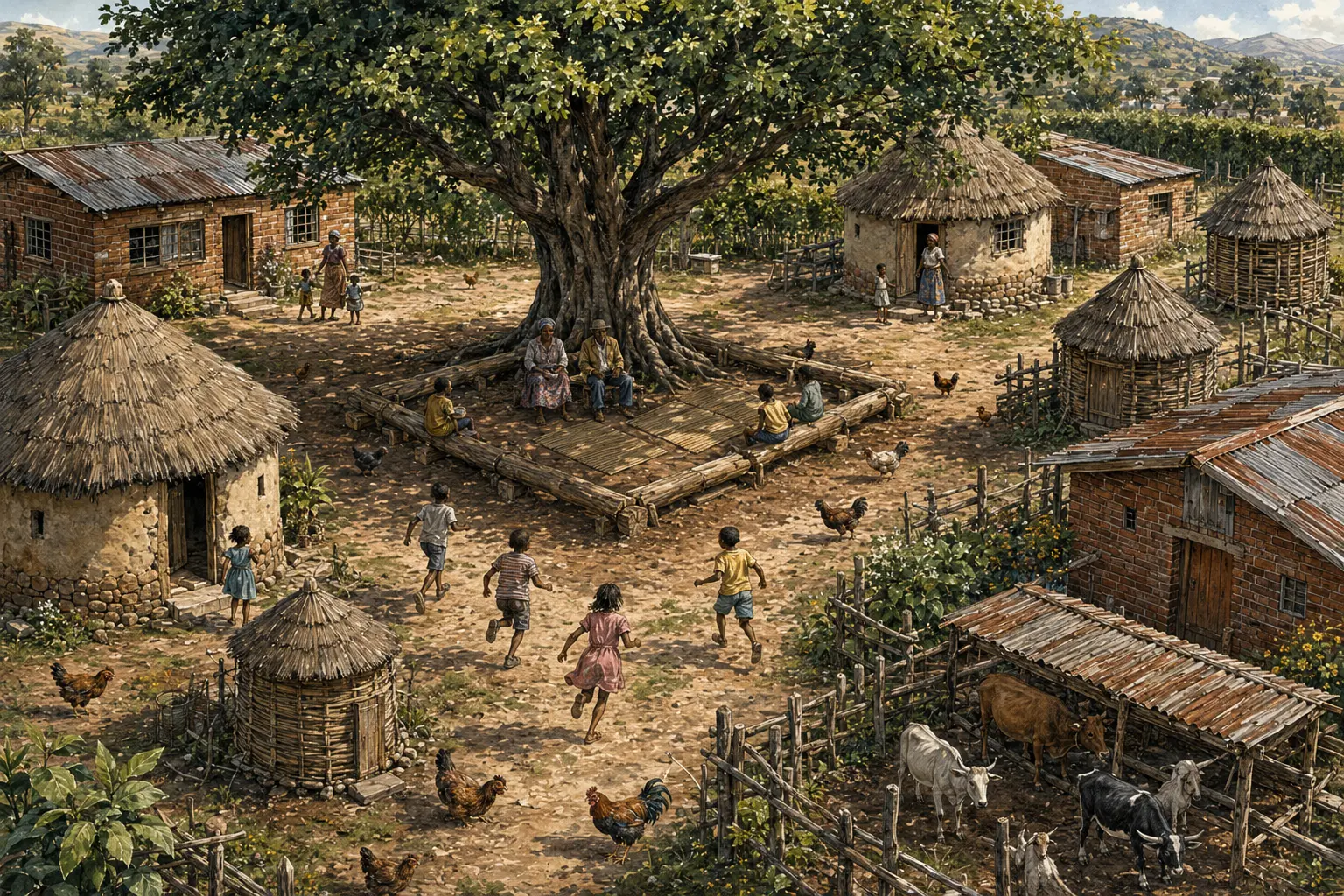
If viewed from above, the Kadira compound might have appeared roughly rectangular, spread across perhaps three thousand square metres. But nobody living within it would have needed a map.
We knew where everyone belonged.
Three modest four-roomed brick houses with asbestos roofs occupied three loose corners, each distinctly marking the home of one of the sons. Beside each stood the familiar round, pointed-thatched kitchen and a granary. Gogo's thatched house sat somewhere towards the middle, with a large granary nearby and a smaller one-roomed asbestos-roofed building used for consultations.
Between Gogo's home and another son's house were the two-bedroomed brick-and-corrugated-sheet homes of my aunties. Around the outskirts sat chicken coops of various sizes and kennels for the lucky dogs; most dogs needed no such accommodation and simply went about their business. Further away were four separate cattle kraals.
Beyond the hedge to the east was the homestead of the eldest son. It was separate, but barely so — perhaps a hundred and fifty yards from the Mun'ando tree.
And the Mun'ando was where we gathered.
It stood only about ten metres from Gogo's hut and provided the ordinary centre of things. Other meeting places changed with the seasons. When the mangoes, guavas and avocados ripened, children migrated accordingly. The mulberry trees attracted us too, although more cautiously. There might be chameleons.
Then there was the house of whichever uncle had most recently arrived from elsewhere. A visiting uncle could mean sweets, new music records and dancing. Geography became very simple when such things were involved.
We wandered freely from one household to another. There were cousins everywhere — younger than us, older than us, the same age as us — alongside friends and whichever other children happened to be around. I grew up inside what I would much later hear described as the idea that it takes a village to raise a child.
We didn't call it anything.
It was simply how things were.
There was no arranged childcare. No discussion about who was supervising whom. Adults and older children shared responsibility for whatever children happened to be within reach. If you fell, somebody picked you up. If you were heading towards danger, somebody stopped you.
If you were misbehaving, unfortunately, somebody stopped that too.
Any adult could intervene. An auntie, uncle, older cousin or neighbour could catch a child doing something forbidden, administer the appropriate correction, escort the offender home and report what had happened. Sometimes the adult would specifically tell the parent not to punish the child again because the matter had already been dealt with.
The parent would thank them.
This meant there was almost nowhere to push a boundary in peace.
Of course, a child might occasionally think, You are not my mother.
Thinking it was one thing.
Saying it would have been quite another.
I discovered the reach of this communal arrangement particularly well on an occasion when the adults had gone to a gathering some distance away. I had been left with my siblings and cousins. Time passed. The adults, in my estimation, were taking far too long to return.
There were several mouths to feed.
I considered the problem and came up with what seemed to me a perfectly workable solution.
My uncle had eggs in his chicken coop. There were also some neatly shelled nuts behind his kitchen door. I could cook the eggs for a meal and roast the nuts afterwards for snacks.
There was, however, the matter of evidence.
It seemed much safer to carry out the entire operation at my uncle's house rather than ours. This would, I reasoned, make the activity considerably more difficult to trace back to me.
It was an excellent plan except for one technical detail I had failed to consider.
Roasting nuts smell.
And in a compound like ours, that smell could travel.
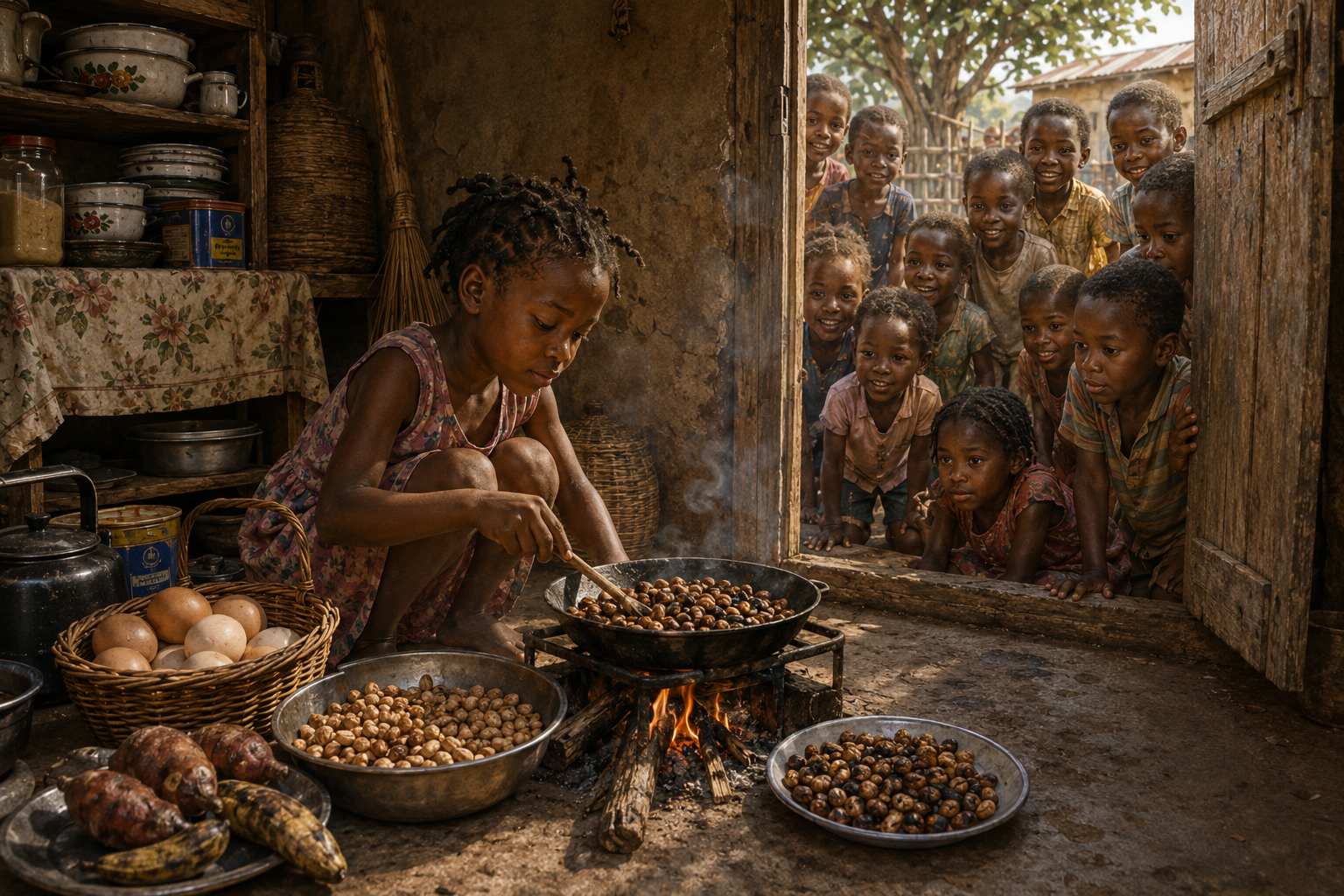
Before long, several additional little mouths had materialised. This expanded gathering eventually attracted the attention of my adult cousin who lived beyond the hedge. She had been calling iwe! to her daughter and receiving no response.
She came looking.
There was nowhere to run.
She burst into my uncle's kitchen and caught me red-handed. Discovering the roasting nuts earned me one smack.
Then she discovered the eggs.
Another followed.
She ordered us back to our own house and announced that she could not wait for our parents to return so she could report what I had done.
Unfortunately, the investigation had not yet revealed the full extent of the offence.
The nuts were seed.
They had been carefully prepared for planting in the fields.
I had roasted them.
What had begun in my mind as the responsible feeding of hungry children had somehow ended with me setting my uncle's family back for the planting season.
Many adults had something to say about that.
By the time the verbal admonishments had travelled around the compound, I made myself a solemn promise never to do such a thing again.
I don't think anybody told my father.
He had a reputation.
For all the adults' apparent ability to know everything, however, children had systems of their own.
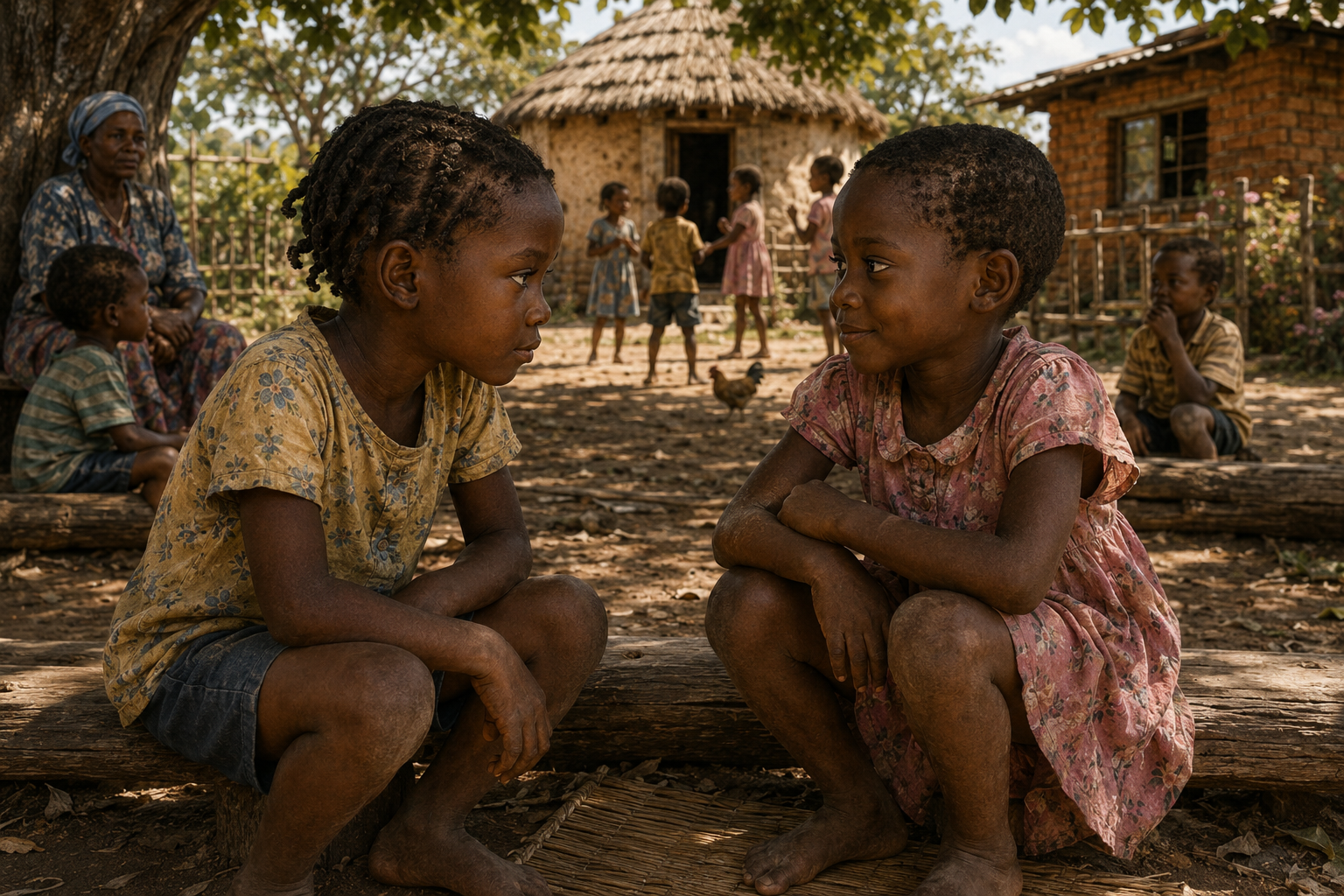
We could speak in eyes.
There was no formal code and nothing needed explaining. We simply knew when something belonged amongst ourselves. Someone had received a hiding from Mbuya Musauti? Nothing to report. Someone had fought another child and lost? That could remain private. A kid — the goat kind — had been accidentally dropped while being initiated into a game of Mums and Dads?
These things happened.
The adults thought they knew everything.
Sometimes they did not.
But childhood responsibility changed the rules.
There was no ceremony marking the moment when you moved from being one of the children being watched to one of those expected to watch the others. Responsibility simply landed, and you ran with it.
When the adults returned, you were expected to give a running report.
That could put considerable strain on children's pacts.
If someone accidentally killed a chick with a catapult while aiming at a bird, for example, silence became harder to defend. The culprit might need to be taken aside and informed that this particular incident would have to be reported.
Some things could stay amongst us.
Some things could not.
We understood the difference.
Looking back, communal childhood contained everything a child might be expected to feel about being surrounded by so many watching eyes. They could be irritating. Restrictive. Intrusive. There were moments when news travelled through the compound like light and you wished very much that it wouldn't.
But there was warmth in those eyes too.
And pride.
You belonged not only to the household in which you slept but to something larger. Responsibility moved in both directions. Other people watched over you until, almost without noticing it, you became old enough to watch over somebody else.
Nobody sat us down to teach us how this worked.
We simply knew.
We were everyone's children.